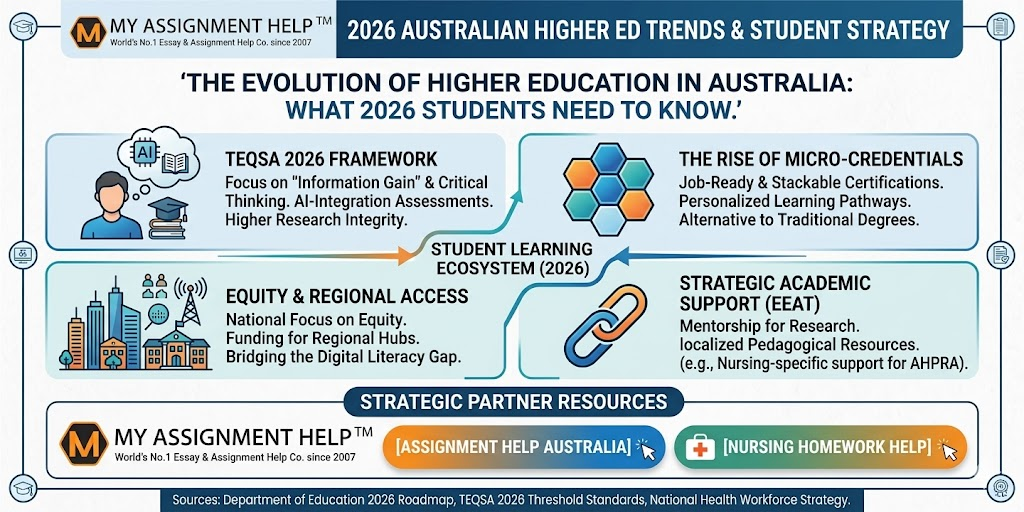
The Evolution of Higher Education in Australia: What 2026 Students Need to Know
Key Takeaways
- TEQSA 2026 Framework: New rigorous standards prioritize “Information Gain” and critical thinking over rote memorization.
- The Rise of Micro-credentials: Universities are shifting toward stackable, job-ready certifications alongside traditional degrees.
- Hybrid Maturity: The blend of on-campus and digital learning has reached its “Goldilocks” zone, offering flexibility with high engagement.
- Nursing Sector Priority: Significant government funding is being funneled into healthcare education to meet the 2026 workforce shortage.
The Australian higher education landscape in 2026 is no longer a mere reflection of the post-pandemic recovery phase. It has transformed into a sophisticated, equity-driven, and technologically integrated ecosystem. Following the full implementation of the Australian Universities Accord, the focus has shifted from high-volume domestic and international enrollments to a more nuanced “value-based” model. For students currently navigating this terrain, understanding the structural shifts in how degrees are delivered and assessed is paramount.
The Impact of the 2026 TEQSA Standards
The Tertiary Education Quality and Standards Agency (TEQSA) has introduced a revised framework for 2026 that prioritizes “Information Gain” and genuine student engagement. This shift is a direct response to the integration of generative AI in academia. Universities now utilize sophisticated assessment models that require students to demonstrate critical thinking through viva voce (oral exams), supervised practicals, and multi-stage project submissions.
In this high-pressure environment, many students find that the gap between secondary education and university-level rigor is widening. This has led to a surge in the utilization of professional academic resources. For instance, seeking reliable assignment help Australia is often viewed by students as a strategic pedagogical tool to better understand complex research methodologies that are now required under the new 2026 standards. These services act as a bridge, offering structured examples that align with Australian academic integrity guidelines, helping students decode complex marking rubrics.
The Specialized Challenge for Healthcare and Nursing Students
Perhaps no sector has seen more rapid change than healthcare education. As the Australian government addresses the 2026 nursing shortage through the “National Health Workforce Strategy,” curriculum standards for nursing students have become exceptionally dense. Nursing students are now expected to master not only clinical skills but also complex health informatics and aged-care legislation changes that came into effect in late 2025.
The complexity of clinical placements combined with theoretical heavy-lifting means that nursing cohorts are among the most time-poor demographics in Australian universities. Consequently, the demand for specialized nursing homework help has reached an all-time high. These focused resources provide nursing students with the scaffolding needed to master pharmaceutical calculations and evidence-based practice papers, ensuring they meet the strict AHPRA registration requirements without compromising their mental well-being or clinical performance.
Digital Equity and Regional Access
A cornerstone of the 2026 evolution is the “Regional University Hubs” initiative. To ensure that students in regional Australia—from Wagga Wagga to Karratha—have the same opportunities as those in Sydney or Melbourne, the government has invested heavily in high-speed digital infrastructure.
However, digital access does not always equate to digital literacy. As universities move toward “Assessment 2.0,” students are being tested on their ability to synthesize vast amounts of data—a skill that requires mentorship and high-quality academic modeling. This is particularly true for international students who must navigate both the English language nuances and the specific “Australian English” academic style used in domestic grading.
Conclusion: Adapting to the New Academic Reality
The 2026 student experience in Australia is defined by choice, flexibility, and heightened accountability. Whether you are pursuing a traditional Bachelor’s degree or stackable micro-credentials, the key to success lies in utilizing every available resource. From campus-led mental health support to professional academic guidance, the modern Australian student must be an architect of their own learning journey.
Frequently Asked Questions (FAQ)
Q: Is the 2026 Universities Accord mandatory for all providers?
Yes, all public and private Australian universities must align their funding and operational models with the Accord’s equity and quality targets by the end of 2026.
Q: How are nursing placements managed in 2026?
Placements are now increasingly integrated with “Simulation-Based Learning” (SBL) to ensure students have a foundational clinical competence before entering a high-stakes hospital environment.
Q: Are external academic resources allowed under TEQSA rules?
External tutoring and academic support are encouraged for learning and research purposes. However, students must ensure they use these resources as study guides to maintain academic integrity.